
AI images: new worlds from data or old thinking ramped up?
Deep Dive
The iconography of GenAI and the present of the past
07.05.2026 – by AXEL ECKSTEIN
A picture is worth a thousand words. But there are also pictures that say just one word: “I”.
These kinds of pictures are all around us, and they have been for longer than it might seem at first glance.
The vast majority of images created today by humans using artificial intelligence, namely generative computer models (GenAI), are nothing more than social signals.
Status preservation
AI images are performative images, not semantic ones. In other words, for the most part, they do not convey any specific meaning inherent in the motif depicted, but merely document the act of participating in the technological-aesthetic present. Performative images encode social status. Their motifs are interchangeable carriers of this status.
These images say: “I use the new technology.” They say: “I can do beautiful things” (Instagram); “I am part of progress” (LinkedIn); “I understand the system” (X); “I have mastered the tool” (Discord); “I have mastered irony” (Reddit).
Posting AI images serves as a means to avert the threat of losing significance and as an anchor for belonging in an accelerated, status-fragile world.
In this way, innovation becomes a social marker that reflects collective emotions. At its core, it is about preserving cultural and, therefore, economic capital.
Posting AI images is not vanity. It is a coping strategy. And its results are so widespread because the actions required to achieve them are very low-threshold.
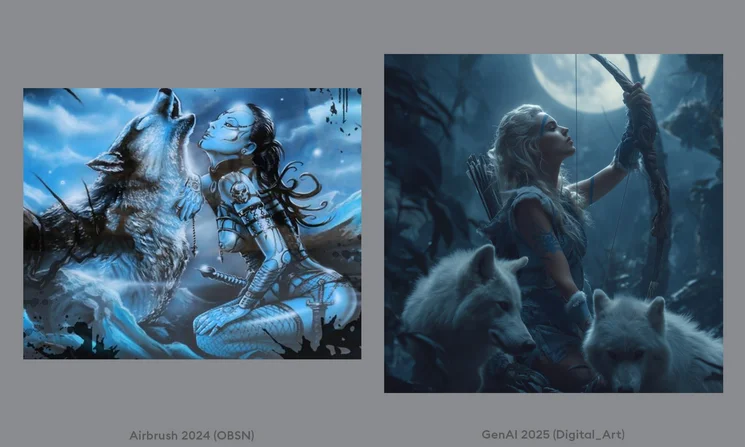
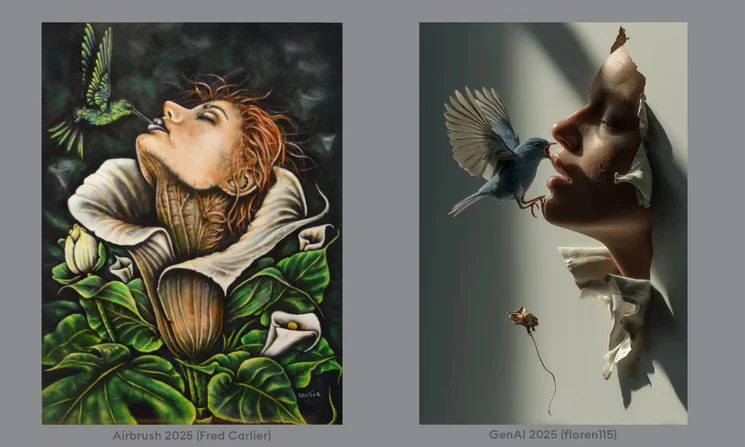
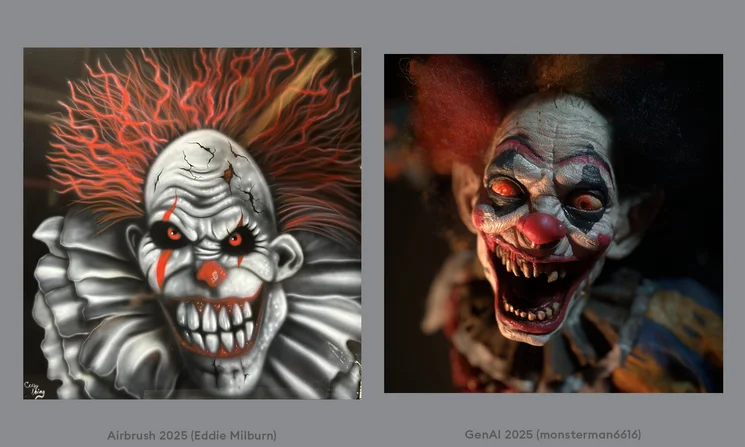
Motif repertoire
The fact that the motifs of performative images are interchangeable does not mean that they are arbitrary.
Across platforms, an estimated 80 % feature animals, humans, and fantasy creatures. Animals are the most common category overall, clearly dominated by domestic and wild cats such as lions and tigers.
Women are seen more than twice as often as men or children. The combination of women and animals or other creatures is also not uncommon.
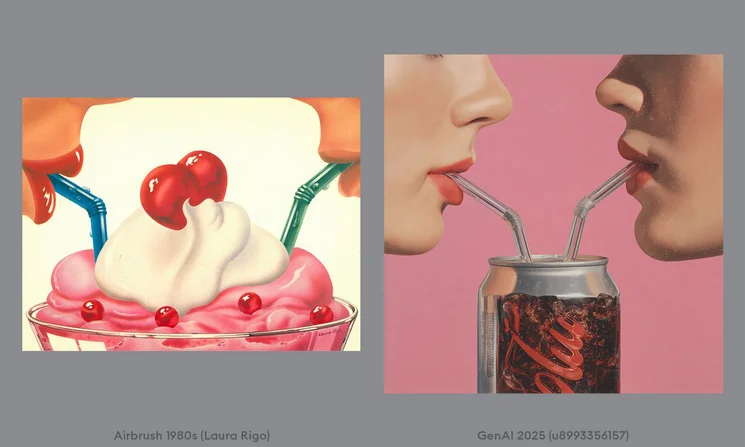
The remaining 20 % of all motifs are divided roughly equally between objects from our consumer world (hamburgers, soft drinks, perfume bottles, sofas, or cars) and cityscapes or landscapes (realistic or fantastical).
Why this pattern? Cats are in first place because they promise maximum resonance with minimal social risk. Cats are morally neutral and open to projection. They accomplish the feat of representing both closeness and independence, which makes them the ideal symbol of modern role models.
Women have always been more aestheticized than men. Today’s visually oriented media and consumer societies further reinforce this tendency. A woman with an animal multiplies the affective potential: blind trust, perfect harmony, untamed wildness.
And pure fantasy creatures — monsters, trolls, superheroes — allow for wonder without a stance. They don’t exist, so we don’t have to discuss them.
What applies to the characters also applies to the typical objects and scenes: the audience is stimulated, but meaning is only simulated. Emotion without position.
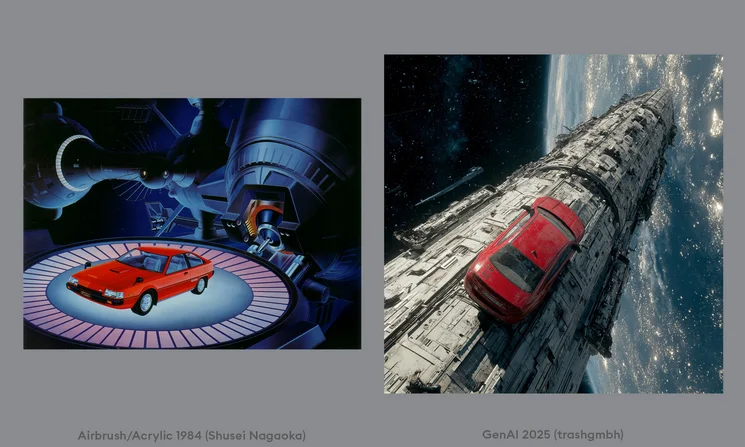
Techno fantasy
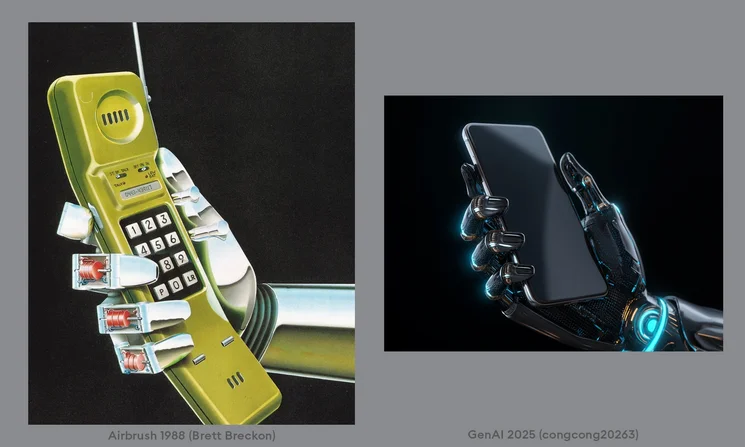
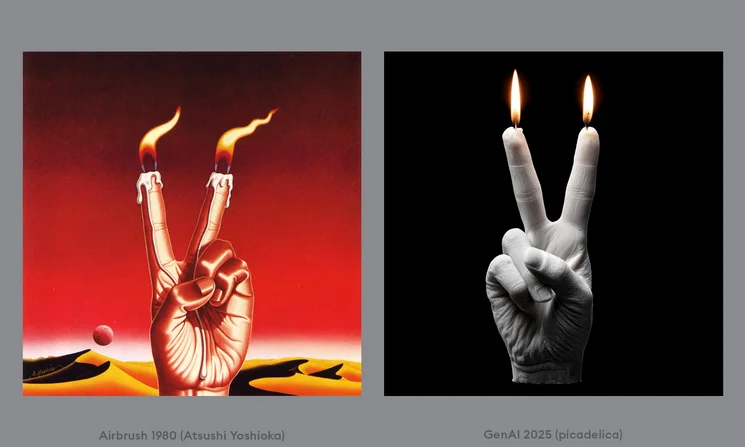
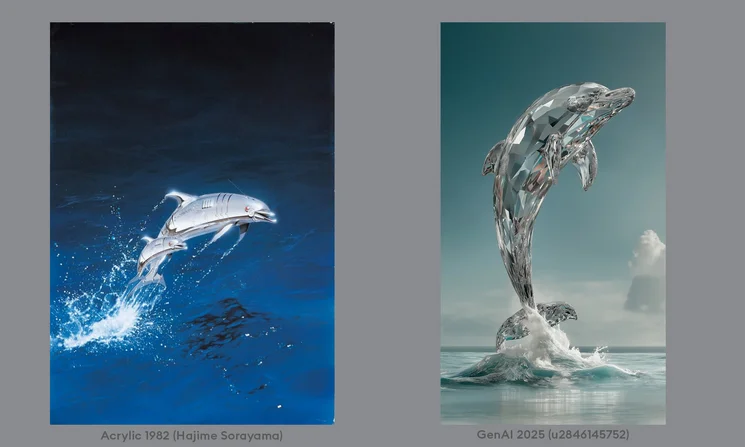
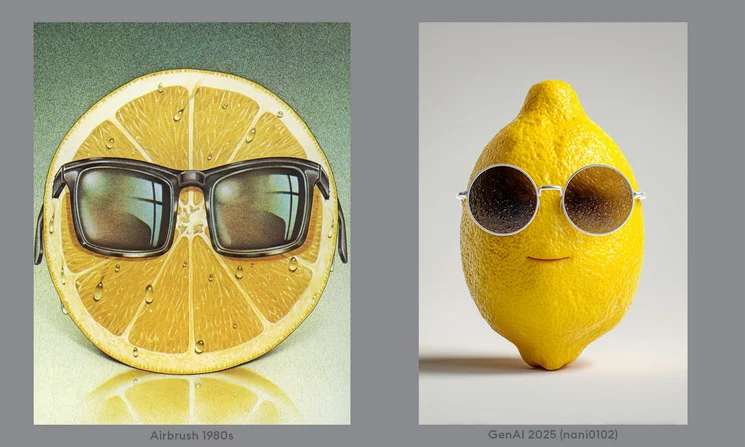
This iconography is not new. GenAI has a predecessor, a historical twin: airbrushing. The spray technique shares not only a similar motif canon with GenAI, but also several other aspects — technical, aesthetic, psychological.
Distance: With airbrushing, the artist does not touch the paper. The perfect surfaces show hardly any traces of work. AI images are also created indirectly and conceal their complex creation process.
Illusion: Airbrushing allows total control of light and sharpness through the finely tuned application of pigment dust, GenAI through precise prompting. Both techniques are painting-like and do not follow a physical world model like classic CGI.
Fantasy: Every artistic technique and its medium triggers decisions about form. Airbrush and GenAI simplify precisely those operations that fictional worlds require: technoid materiality, cosmic nebulae, unreal glows.
Whether with a spray brush or a keyboard, people feel compelled to be “creative”, even without having anything to say. Too much freedom with too little necessity: the shortest route to cliché.
Baby schema
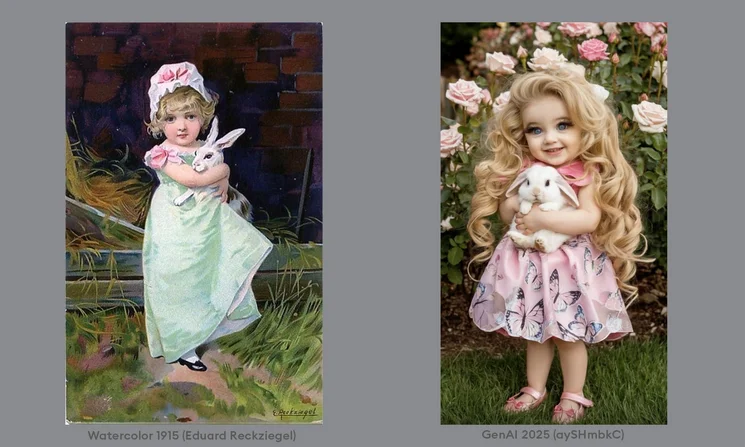
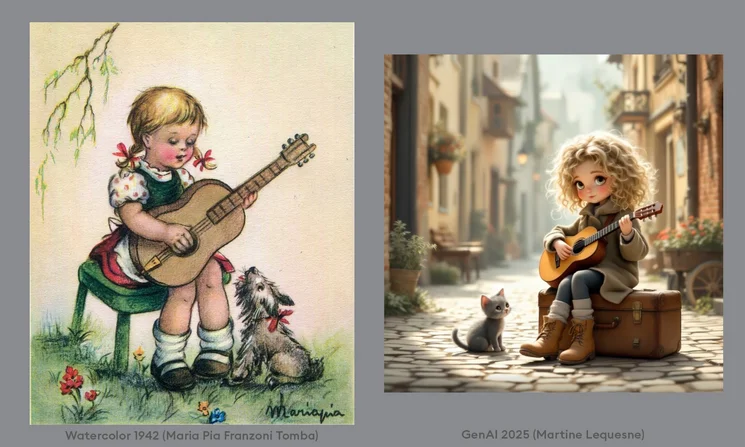
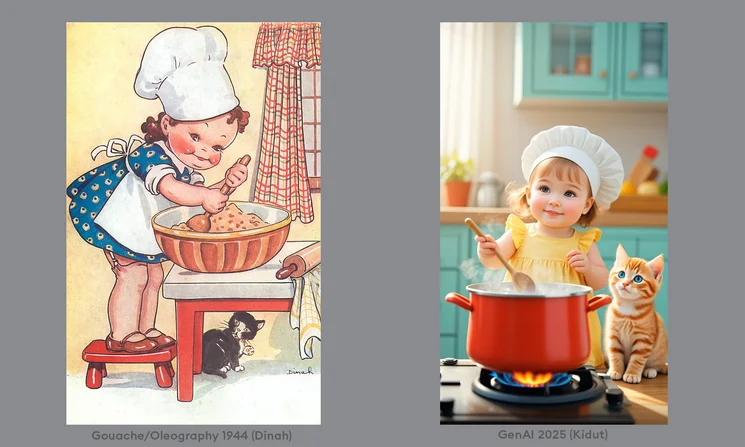
As striking as the parallels may be, one motif category that is important for GenAI remains underrepresented in airbrush art: cuteness. For today, as in the 1970s and 1980s, airbrush art is particularly popular in groups that associate escapism with strength and freedom. The tank of a Harley is simply not a place for puppy dog eyes.
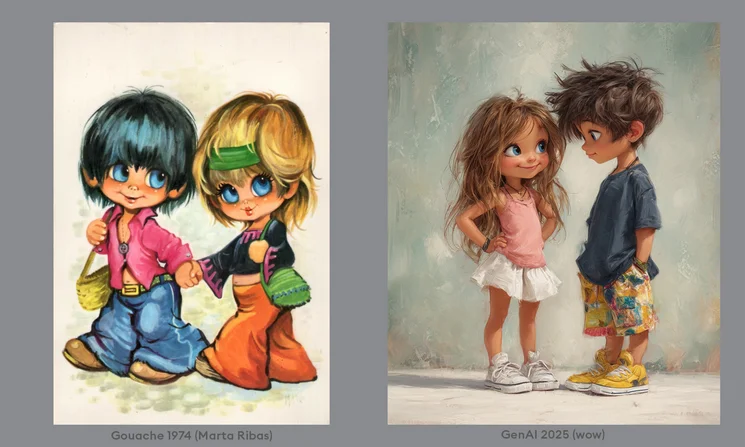
But cuteness also has a forerunner: the big-eyes wave of the 1960s and 1970s. At that time, the market was flooded with illustrations of boys and girls in which the childish features were taken to grotesque extremes.
When compared to AI images, such kitsch illustrations share fewer traits than airbrush works. Parallels exist primarily on an emotional level.
It’s about the immediate activation of comforting feelings without any conflict: no politics, no sexuality. Cute images offer regressive security in an uncertain affluent society. Progress is unstoppable, but it seems to be taking something away from us. Cute images are comfort without insight.
GenAI reproduces such images even more massively than Spanish kitsch postcard publishers ever did, shifting the European perspective to an Asian one. Fed by training data from anime and game ecosystems and pushed by platforms that algorithmically reward cuteness.
GenAI brings everything together. It devours all images of the past, combines the technical smoothness of airbrushing with a global cute aesthetic, and accelerates moments of sentimentality to the speed of likes.
Machine logic
Every zeitgeist leaves its mark on images, but regardless of this, a characteristically limited repertoire of motifs is a principle of every new imaging technology. This is due to the logic of the machine alone.
When color film was introduced, photographers rushed to shoot bouquets of flowers, bowls of fruit, and patterned fabrics.
When photography itself was first invented, the pioneers pointed their low-light plate cameras at the motionless parts of the world: serious citizens, dried insects, and deserted squares.
Users initially focus on familiarizing themselves with the new technology. Consciously choosing a subject is tedious, because they would much rather just watch the miracle machine do its work. And then talk about it with everyone else.
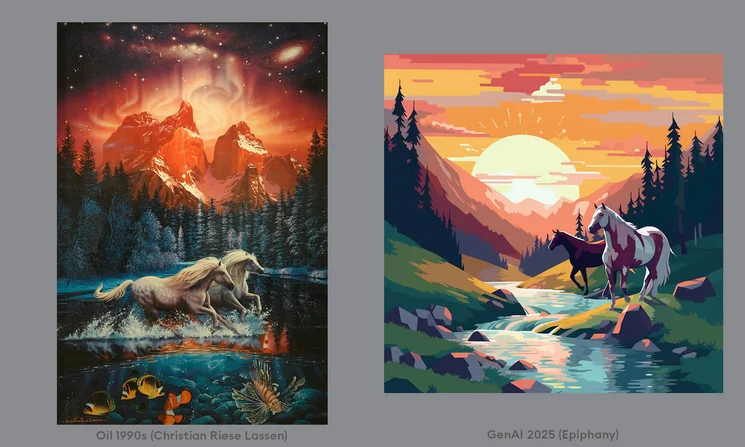
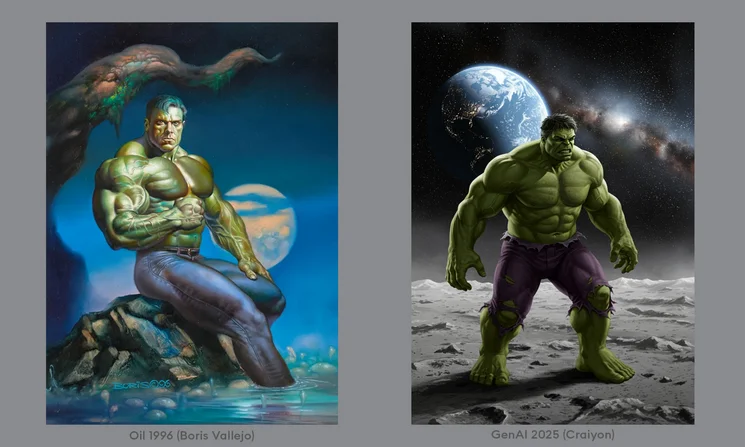
Image control
Historical parallels can of course also be found in the critical reactions to new technologies.
In the beginning, photography was considered a lazy, unimaginative corrupter of art and as an instrument of power over reality that also attracted fraudsters.
In 1862, William H. Mumler used secret double exposures to make “ghosts” appear in portrait photos. He was arrested for deceiving unsuspecting people.
Courts, academies, and publishers supported measures to ensure trust in photography, and reputable studios increasingly authorized their works with a seal of approval.
In 2025, the American fashion company Guess published an advertising campaign featuring AI-generated models in Vogue magazine. This sparked outrage on social media over the promotion of beauty standards that were perceived as unrealistic and having a negative effect on girls and women.
In the same year, Kathy Hochul, Governor of New York State, passed a law requiring advertisers to disclose the use of “AI-generated images and synthetic performers” in campaigns.
History does not repeat itself exactly, but it rhymes, and it shows that the creation and perception of images have always been subject to certain formulas.
Soul Mirror
Before AI, even kitsch painters pretended that their paintings were expressions of individual talent.
AI finally severs the connection between skill and image impact, only to leave us right back where we always were. What remains is our desire: universal emotionality without individual responsibility. The “real” is neither necessary nor missed, because it was also burdensome.
The machine wants nothing and dictates less to us than we think. Sure, there is a tendency toward stereotypical images: basketball players are usually black, golfers white. But we humans created the gigantic image pool used to train AI ourselves in the time before its invention.
It is not GenAI that produces stereotypes – we do. While we take care to maintain control and receive love. Yesterday, today, and tomorrow.
GenAI is now removing the remnants of what had concealed this. Now everyone is joining in.
Technically speaking, we could easily out-prompt the convergence of AI images for more targeted, specific results. But we do it much less than we don’t.
What GenAI produces are not images, but mirrors. Mirrors in which it is hardly the individual that is reflected, but humanity as a whole. Something that connects us psychologically.
Seen in this light, AI images may be very honest images.