
To label AI content or not?
19.08.2026
The other key provisions of the ‘European AI Act’ that must be observed from August 2026 onwards are surprisingly sensibly worded.
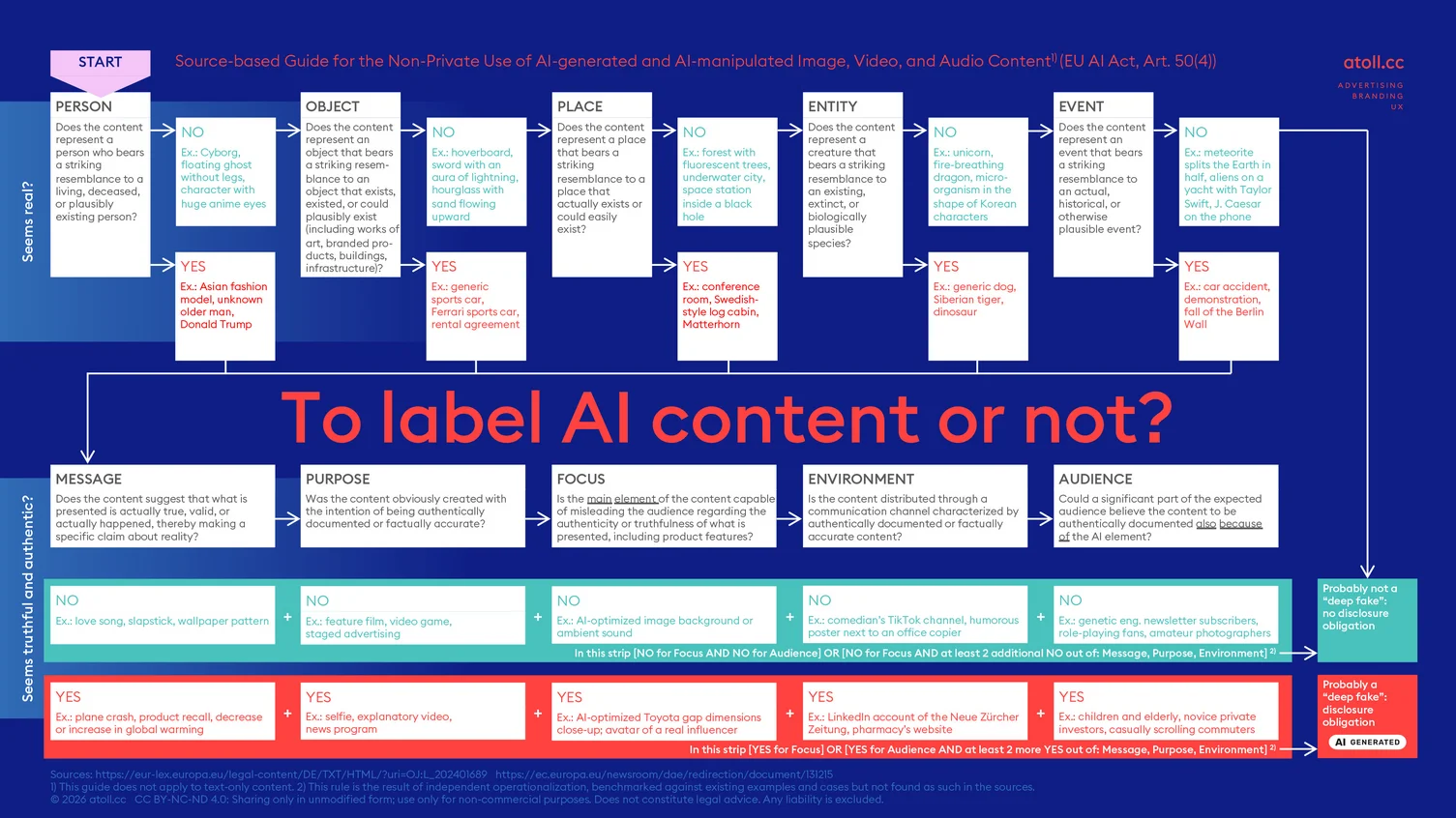
Of particular relevance to advertising companies and agencies is the new transparency requirement for certain AI-generated and AI-manipulated image, video and audio content (Article 50(4)–(5)).
The problem is that implementing this is not at all straightforward.
Companies and agencies should therefore not be surprised if they do not get it right straight away. And perhaps for this very reason, they may, as a precaution, feel they need to label all their AI content – which in many cases is not necessary at all.
We have attempted to bridge this gap, whilst adhering strictly to the original EU sources.
The result is a unique assessment framework that can raise the accuracy rate in determining whether something should be regarded as a ‘deepfake’ requiring labelling from approximately 64 per cent (initial impression) to 97 per cent (thorough assessment).
Background
The aim of the transparency requirement is to minimise the risks arising from the fact that it is becoming increasingly difficult for people to distinguish between synthetic and authentic content.
The transparency requirement is a targeted response to the increased potential for content to be misleading as a result of AI.
For image, video and audio content that must be labelled, the legislator uses the unfortunate term ‘deepfake’, which is generally understood by the public in a narrower sense and primarily as face or voice replacement.
Important: Within the framework of the EU AI Act, the term ‘deepfake’ does not in itself indicate that the content is illegal.
Accessibility
The transparency requirement governs not only whether labelling is required, but also how it should be carried out.
A ‘deepfake’ must be recognisable as
AI-generated or AI-modified content upon first contact with the public.
The relevant information must comply with the applicable accessibility requirements.
Deployers vs. providers
The transparency requirement applies to both ‘deployers’ and ‘providers’ of AI systems.
Deployers use an AI system on their own responsibility as part of a professional activity (e.g. an advertising agency or an advertiser with in-house creative teams).
Who is considered a deployer does not depend solely on who enters the prompt, but ultimately on under whose authority or responsibility the AI is used.
An agency may be the deployer but so may a client if the agency uses the AI system on the client’s behalf.
As an agency cannot alone ensure the necessary disclosure until the point of contact with the public, it is usually the client who ensures that the correct labelling remains visible or is supplemented.
Providers are often large tech companies that develop AI systems and make them available for use (e.g. OpenAI).
Providers must ensure that the output of the AI system is labelled in a machine-readable format and is recognisable as having been artificially generated or manipulated.
Google, for example, meets this requirement with Google SynthID, an invisible label that remains readable even after video editing.
A deployer cannot be held liable for a breach of this obligation, which the law explicitly and exclusively imposes on the provider.
Implications for Switzerland
Switzerland does not yet have a comparable AI law. However, the federal government is preparing its own regulations to implement the Council of Europe’s AI Convention in Switzerland.
Nevertheless, EU law – including the AI Act – may already affect Swiss companies today. This is the case, for example, when their services are specifically targeted at the EU market: the ‘place of supply’ principle.
When determining whether a Swiss offering is directed at the EU, criteria from existing case law on cross-border transactions can serve as a guide.
Indications of such ‘targeting’ include: prices quoted in euros, an EU delivery option, country-specific top-level domains such as ‘.de’, and the targeted placement of advertising in EU regions (geotargeting).
Conversely, mere technical accessibility from within the EU is unlikely, on its own, to constitute sufficient evidence of such targeting.